
Most homeowners pick a roof the way they pick paint. Choose a color — driftwood, weathered wood, onyx black — sign the contract, and assume everything underneath is the same no matter who does the work.
It isn’t. And the parts you can’t see are what decide whether the roof lasts twelve years or thirty.
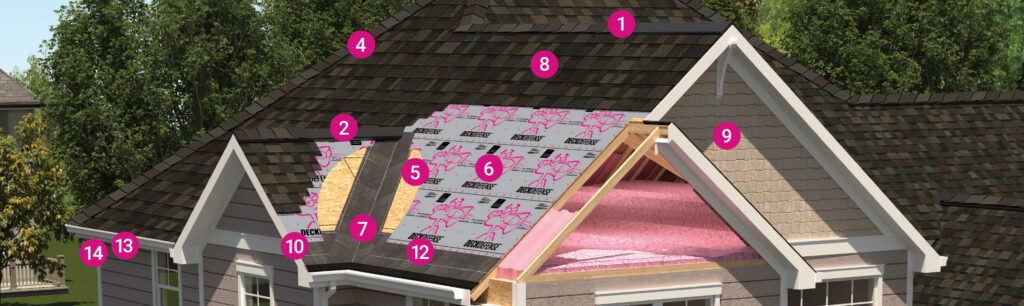
Shingles are the outer shell. Beneath them sits a system of five layers, each with a specific job, and each one a place where a contractor can quietly reduce cost. Two bids that look identical on paper can be built very differently below the surface.
Here’s what belongs under a properly built roof, and what to ask about before you sign.
1. A solid roof deck
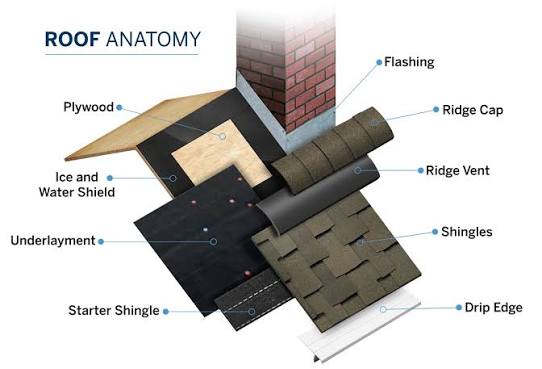
The deck — plywood or OSB sheathing nailed across your rafters — is what everything else fastens into. If it’s soft, delaminated, or rotted, no material laid on top of it will hold.
This is the argument for a full tear-off. A crew that lays new shingles over the old ones never sees the deck. Damage from years of small leaks around a chimney, in a valley, or under a failed vent boot stays hidden and keeps spreading under a brand-new roof.
Expect your contractor to walk the deck after tear-off and replace any sheet that’s compromised. Ask how decking replacement is priced before work starts. Most contracts include a set number of sheets and charge per sheet beyond that, which is normal — you just want to know the number in advance rather than on the final invoice. If you’re still weighing whether you need a full replacement at all, our breakdown of roof replacement vs. repair walks through it.
2. Synthetic underlayment
For decades the only option was felt — asphalt-saturated paper sold as 15-pound or 30-pound. It works, but it tears in wind, wrinkles when it gets wet, and gets chewed up under foot traffic during installation.
Synthetic underlayment replaced it for good reason. It’s far stronger, it won’t absorb water, it lies flat, and it holds up when a crew is walking on it in August heat.
This is the continuous secondary barrier across your entire deck. Wind-driven rain gets past shingles on every roof eventually — underlayment is what it hits instead of your plywood.
3. Self-adhering ice and water shield
This one doesn’t cover the whole roof. It goes where water actually collects and backs up: valleys, eaves, rake edges, and around every penetration — plumbing vents, chimneys, skylights, satellite mounts.
It’s a thick rubberized membrane that adheres directly to the deck. Its real advantage shows when a nail goes through it: the rubber seals around the nail shank, so the fastener hole doesn’t become a leak path.
In northeast Indiana this is not a nice-to-have. Ice dams form when attic heat melts snow on the upper roof, that water runs down to the cold eave, refreezes, and backs up underneath the shingles. Ice and water shield along the eaves is what keeps that water off your decking. Our guide to preparing your roof for Indiana’s winter weather covers the ice dam problem in more depth.
4. Drip edge flashing
A formed piece of corrosion-resistant metal running the full perimeter of the roof, along both eaves and rakes. Small component, disproportionate consequences.
Its job is to carry runoff off the roof edge and into the gutter rather than letting it curl back underneath. Water clings to surfaces and travels along them — without drip edge it wicks behind the gutter onto your fascia and soffit, and you get rot in the one part of the roof you look at from the driveway every day.
Drip edge is required by current building code in most areas, and it’s among the cheapest components on the roof. Leaving it out, or reusing bent stock off the old roof, is a margin decision rather than a technical one.
One practical note: if your gutters are the same age as your roof, doing both at once usually costs less than two separate jobs, since seamless gutter installation shares the same setup and tear-off.
5. Starter strip and ridge cap shingles
Two places where standard field shingles don’t do the job — and where the shortcut is invisible once the roof is finished.
Starter strip runs along the eaves and rakes. It’s a purpose-made product with a continuous adhesive bead positioned to grab the bottom edge of the first course of shingles. Some crews save money by cutting up regular shingles to use as starter, which puts the adhesive in the wrong place. The first course never bonds properly, and that’s the row that lifts first in high wind.
Ridge cap shingles go over the ridge vent at the peak. They’re thicker and pre-formed to fold over the ridge without cracking. Field shingles cut into thirds crack at the fold, especially when installed in cold weather.
The ridge vent underneath matters as much as the cap over it. It lets hot, moist attic air escape — without working ventilation you get heat buildup in summer, condensation in winter, and shortened shingle life. It’s also why most shingle manufacturers tie their warranty coverage to adequate ventilation.
Five questions worth asking before you sign
The answers tell you more about a bid than the price does:
- What brand and type of underlayment are you installing — synthetic or felt?
- Exactly where does ice and water shield go? (Eaves, valleys, rakes, penetrations — get it specific.)
- Is new drip edge included on both eaves and rakes?
- Is the starter strip a manufactured product, or cut from field shingles?
- How is decking replacement priced, and how many sheets are included in the base bid?
A contractor who answers these easily is telling you they build roofs this way routinely. One who gets vague is telling you something too. Our guide on choosing the right roofing contractor covers the rest — licensing, insurance, and warranty terms.
Common questions about roofing systems
Can a new roof be installed over the old shingles?
Code sometimes permits it, but it hides the decking from inspection, adds weight, traps heat, and shortens the life of the new shingles. Most manufacturers also limit warranty coverage on layovers. A full tear-off is the only way to find and repair deck damage.
Does ice and water shield need to cover the whole roof?
Usually not. It belongs at the eaves, in valleys, along rake edges, and around every penetration. Fuller coverage is sometimes specified on low-slope sections where water drains slowly.
Is synthetic underlayment worth the added cost over felt?
The material difference on a typical home is small next to the total project cost, and synthetic won’t tear, wrinkle, or absorb water. On a roof meant to last 25 years or more, it’s an easy call.
How do I know when I need a new roof in the first place?
Age, curling or missing shingles, granules in the gutters, and interior water stains are the usual indicators. We covered the full list in 7 signs it’s time to replace your roof.
Allied Exteriors builds systems, not just roofs
Plenty of contractors will quote you a lower number. The savings almost always come out of the layers in this article, because those are the ones you’ll never see again once the shingles go down.
We build from the deck up: synthetic underlayment, ice and water shield where water actually collects, new drip edge on every edge, manufactured starter strip, and proper ridge cap over a working ridge vent. As an Owens Corning Preferred Contractor, we install these as integrated systems rather than a collection of separately sourced parts.
Every roof we install is built to that spec, whether or not you thought to ask.
Schedule a free roof assessment and we’ll walk you through exactly what’s going on your home — or browse our recent roofing projects to see the work.